

Half Moon




Showing 1-10 of 10 item(s)
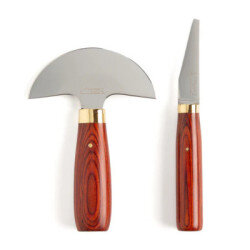
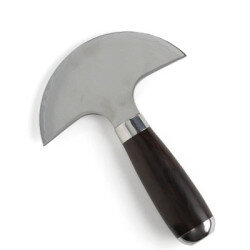
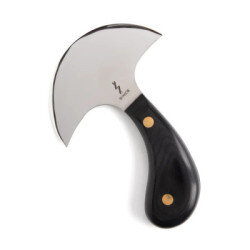
The "half moon", is a type of cutting knife to leather, whose semi-circular blade reminiscent of the shape of the Moon, hence comes the curious name. Sharp knife for cutting and slimming leather easily. Various sizes: small, medium and large. Manufactured in steel, Damascus steel.
Half Moon Knife: The masters secret Tool for Leather Cutting
In the craft of leatherworking, the pursuit of both precision and efficiency is a constant. Among the array of specialized tools, the half moon knife—also widely known as the round knife—stands out as a cornerstone for generations of saddlers and leather artisans. Revered for its adaptability, strength, and the control it offers, this tool is indispensable for a wide spectrum of tasks—from cutting thick saddle skirting to refining details on decorative inlays or even shaping the outlines for bespoke knife and sword sheaths.
The Half Moon Knife: Shape, Versatility, and Heritage
Instantly recognizable by its sweeping half-moon shaped blade, the half moon knife is engineered for versatility. The curved edge allows it to glide through leather with ease, making both straight and curved cuts possible with a simple adjustment of wrist and grip. Unlike straight-bladed knives, the round knife’s arched profile lets artisans slice through thick hides, trim fine patterns, and skive edges by changing the angle at which it meets the material. This level of adaptability has made it the traditional choice for saddlery workshops and leathercraft studios worldwide.
The design also provides exceptional control for intricate shapes. By rotating the blade slightly while cutting, leatherworkers can produce sharp turns or sweeping arcs—a necessity for cutting the flowing curves of saddle skirts, and other complex components. For straight lines, the knife’s broad expanse allows long, steady cuts across stiff, heavy leathers.
Types of Half Moon Knives: Size, Blade Form, and Materials
Modern and traditional half moon knives are available in a variety of sizes, with blade widths commonly ranging from about 4 inches to over 6 inches. Smaller blades enable finer, controlled work and are often favored for crafts such as sheath making, where intricate contours are the norm. Larger blades excel at long, sweeping cuts and at handling multiple layers of leather, making them ideal for heavy-duty saddlery uses.
The blade form itself may exhibit subtle differences in curvature or edge profile. Some round knives feature a pronounced curve for rapid maneuvering, while others have a flatter arc for increased stability. The grind and sharpness are critical—a razor-sharp edge ensures effortless, safe cutting, while a blunted edge increases risk and fatigue.
As for materials, the most valued half moon knives are forged from high-carbon or tool-grade steel, renowned for holding a fine edge through repeated use on tough hides. Traditional handles are crafted from hardwoods for durability, while modern variants may feature composite or ergonomic grips that reduce fatigue during long cutting sessions.
When and Where the Half Moon Knife Excels
The role of the half moon knife is especially prominent in leather workshops. It is employed for cutting out main saddle components—including skirts and billets—from large sides or bends of leather. Because these parts require both precision and strength, the round knife’s design lets the artisan follow detailed patterns with clean edges while applying enough force to get through thick material.
Beyond rough cutting, the broad blade is also used for edge skiving, thinning down borders so they may be bent, overlapped, or stitched flat. For straight cuts, placing two hands on the handle gives control and leverage, while for tight curves or notches, a single hand and twisting motion allows the edge to follow any template. This adaptability makes the half moon knife the quintessential all-purpose leatherworker’s blade, still irreplaceable in professional.
While power equipment and rotary cutters have their place in some modern workshops, only a well-honed half moon knife can combine the intuitive feel and detailed control needed to address the variations in every hide. Its use is not limited to saddles—the knife often appears in craft and repair work for knife and sword sheaths, wallet panels, belts, and other custom pieces, whenever a clean, flexible cut is required.
How to Use the Half Moon Knife Effectively
Mastering the half moon knife begins with proper grip and maintenance. To operate safely and efficiently, the blade should always be sharpened and stropped until it easily glides through the thickest leather stock. The user typically grips the handle with the dominant hand, laying the off-hand on the other side for stability during long cuts. For controlled curves, one hand guides the blade tip, adjusting pressure and direction as needed.
Position the leather on a sturdy surface—many artisans use a heavy cutting board or slab for best results. Carefully follow the template lines, letting the round blade’s shape turn naturally along arcs and corners. For skiving, hold the blade almost parallel to the leather and gently shave thin layers until the desired feather is achieved. Clean, regular maintenance is crucial to safety; a dull knife demands excessive force and risks slips or uneven results.
Conclusion: Essential for Quality Saddlery and Leathercraft
The half moon knife is more than a relic of traditional leatherworking—its efficiency, versatility, and control make it an enduring favorite of professional saddlers and serious enthusiasts alike. Whether cutting thick saddle leather, shaping curved details, or refining the edges for decorative sheaths, a quality round knife remains the tool of choice for those who seek both speed and precision in their craft. For the leatherworker, mastering this tool is both a rite of passage and the foundation for producing exceptional, long-lasting work.