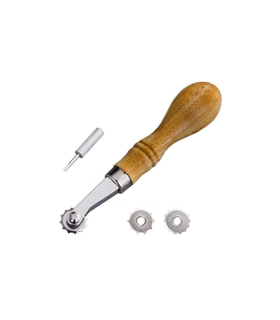
Overstitchers
Roulette or wheel spacer to mark space of sewing stitches easy and fast. Crafters and saddlers used it to mark the distance between stitches. Wheel overstitchers, wing divider,...
Overstitchers in Leatherwork: Stitch Perfection for Saddlery and Craft
Leatherwork is as much about refined detail as it is about strength and utility. Nowhere is the pursuit of perfection more apparent than in saddle-making, custom belts, or even precisely sewn knife sheaths. A keen eye will instantly spot neat, even stitches—an unmistakable signature of professional technique. This consistency is made possible by a suite of specialized tools, among which overstitchers play a central role. These practical, often underappreciated, tools guide the artisan to create straight, uniform stitching lines, ensuring every seam is as beautiful as it is durable.
The Critical Role of Overstitchers in Leather Craftsmanship
Overstitchers are tools specially designed to mark the location and spacing of stitches before, and sometimes after, sewing. Without such guides, even the most talented artisan would struggle to keep hand stitches locked in an even row—essential for both the look and resilience of the seam. In saddlery, where seams must withstand years of rugged use, consistent stitch lines are a matter of both functional reliability and aesthetic pride.
Overstitchers enable crafters to lay out stitch marks accurately, resulting in a professional finish. They prevent “wandering” or uneven stitches, which not only weaken the seam but also mar the clean look customers expect of fine saddles, holsters, belts, and custom sheaths.
Types of Overstitchers: Roulette and Fork Pricking Irons
The world of overstitchers primarily includes two categories: the roulette wheel (sometimes called a pricking or marking wheel) and the fork-style pricking irons.
The roulette overstitcher consists of a handle attached to a small, toothed wheel. This wheel is rolled along the leather where stitching is planned, leaving a series of fine, evenly spaced marks. These marks indicate precisely where each needle pass will go, guiding the awl or the needle itself. Roulette overstitchers are available with various wheels, each with a specific stitches-per-inch (SPI) spacing, allowing customization for heavy-duty tack, delicate saddlery, bags, or custom knife sheaths. The tool can also be run along curved edges, accommodating the flowing lines of saddles or ornate sheath designs with ease.
Fork-style overstitchers, more commonly called pricking irons or stitching forks, resemble a fork with several prongs. By placing and tapping the fork into the leather, equally spaced holes or marks are produced along a line. These tools are especially popular for straight lines and precise corners where control over stitch placement is critical. With their different prong counts, pricking irons allow the artisan to mark long stretches (with more teeth) or navigate curves and tight spaces (using fewer). The choice depends on the thickness of the leather and the style of the project being made.
When to Use Overstitchers in Saddlery and Leatherwork
The primary moment for using an overstitcher is before stitching—either hand or machine—to plan out and mark where each stitch will run. For saddlery, overstitchers are essential on saddle skirts, billets, fenders, rein straps, and virtually all stitched components that require straight or decorative seams. Hand-stitching, in particular, almost always starts with roulette or fork-marked holes to ensure the dual-needle saddle stitch remains perfectly aligned throughout the project.
Overstitchers are also invaluable for curved seams, common in shaping the skirts and padding of English or Western saddles, or in the rounded edges of stirrup leathers and fenders. The ability to roll a roulette wheel along a template or to use a strategically placed pricking fork gives the leatherworker full control over the stitch line, even on intricate shapes.
In knife or sword sheath making, overstitchers ensure that seams follow the intended line, whether straight down a welt or in a decorative scroll. Ofter, after sewing, artisans will re-roll the overstitch wheel down the finished line to “set” the stitches—bedding them lightly into the leather and refining the overall appearance. This compresses the thread into the groove, helping prevent wear and reinforcing the stitch’s longevity.
How to Use Overstitch Tools Effectively
Effective use of any overstitcher begins with sharpness and matching the tool to your desired look. The chosen spacing must fit the thickness of the leather and the style of the item. Typically, fewer stitches per inch (wider marks) are used for heavy tack and saddlery, while finer, closer spacing is preferred for thinner or more refined goods.
For the roulette wheel, start by marking a straight (or gently curved) guide using a compass, ruler, or creaser. Run the wheel steadily along the line, keeping consistent speed and pressure for even marks. Curved contours, such as those found on padded saddle seats or sheath outlines, can be tackled by carefully rolling the wheel along a template.
When using pricking forks, line up the first mark on the guideline, tap the fork with a mallet, remove, and then overlap the last prong with the first mark for perfect continuity. This technique takes some practice but rewards with flawless stitch lines across even the longest seams.
After marking with either tool, a diamond or round awl is then used to pierce the holes, taking care not to deviate from the guide. Once the stitching is complete, running an overstitch wheel again over the sewn thread compresses it into the leather, smoothing the finished look and keeping threads in place.
Beyond Saddlery: Overstitchers for Belts, Bags, and Sheaths
Outside the saddle shop, overstitchers see frequent use in belts, wallets, bags, or any leather item where parallel, tight stitch rows define quality. For knife and sword sheaths, the tools guarantee that stitches hug the edge and evenly follow curves, whether for functional strength or purely decorative detail. Regardless of project, spend time mastering overstitch tools—you’ll develop the muscle memory needed for fast, professional results.
Conclusion: Overstitchers—The Unsung Heroes of Leather Stitching
No matter the niche—from traditional saddlery to custom sheaths and belts—overstitchers are central to professional-grade results in leatherwork. Roulette wheels and fork-style overstitchers make it possible to achieve neat, resilient seams that stand up to years of use and scrutiny. By mastering their selection and use, leatherworkers at any level ensure every stitch begins, follows, and ends in line—a hallmark of true craftsmanship.